A nice picture we received from the Heralds in Ponta Grossa


A nice picture we received from the Heralds in Ponta Grossa
MESSAGE OF HIS HOLINESS
POPE BENEDICT XVI
FOR THE 44th WORLD COMMUNICATIONS DAY
“The Priest and Pastoral Ministry in a Digital World:
New Media at the Service of the Word”
[Sunday, 16 May 2010]
Dear Brothers and Sisters,
The theme of this year’s World Communications Day – The Priest and Pastoral Ministry in a Digital World: New Media at the Service of the Word – is meant to coincide with the Church’s celebration of the Year for Priests. It focuses attention on the important and sensitive pastoral area of digital communications, in which priests can discover new possibilities for carrying out their ministry to and for the Word of God. Church communities have always used the modern media for fostering communication, engagement with society, and, increasingly, for encouraging dialogue at a wider level. Yet the recent, explosive growth and greater social impact of these media make them all the more important for a fruitful priestly ministry.
All priests have as their primary duty the proclamation of Jesus Christ, the incarnate Word of God, and the communication of his saving grace in the sacraments. Gathered and called by the Word, the Church is the sign and instrument of the communion that God creates with all people, and every priest is called to build up this communion, in Christ and with Christ. Such is the lofty dignity and beauty of the mission of the priest, which responds in a special way to the challenge raised by the Apostle Paul: “The Scripture says, ‘No one who believes in him will be put to shame … everyone who calls on the name of the Lord will be saved.’ But how can they call on him in whom they have not believed? And how can they believe in him of whom they have not heard? And how can they hear without someone to preach? And how can people preach unless they are sent? (Rom 10:11, 13-15).
Responding adequately to this challenge amid today’s cultural shifts, to which young people are especially sensitive, necessarily involves using new communications technologies. The world of digital communication, with its almost limitless expressive capacity, makes us appreciate all the more Saint Paul’s exclamation: “Woe to me if I do not preach the Gospel” (1 Cor 9:16) The increased availability of the new technologies demands greater responsibility on the part of those called to proclaim the Word, but it also requires them to become become more focused, efficient and compelling in their efforts. Priests stand at the threshold of a new era: as new technologies create deeper forms of relationship across greater distances, they are called to respond pastorally by putting the media ever more effectively at the service of the Word.
The spread of multimedia communications and its rich “menu of options” might make us think it sufficient simply to be present on the Web, or to see it only as a space to be filled. Yet priests can rightly be expected to be present in the world of digital communications as faithful witnesses to the Gospel, exercising their proper role as leaders of communities which increasingly express themselves with the different “voices” provided by the digital marketplace. Priests are thus challenged to proclaim the Gospel by employing the latest generation of audiovisual resources (images, videos, animated features, blogs, websites) which, alongside traditional means, can open up broad new vistas for dialogue, evangelization and catechesis.
Using new communication technologies, priests can introduce people to the life of the Church and help our contemporaries to discover the face of Christ. They will best achieve this aim if they learn, from the time of their formation, how to use these technologies in a competent and appropriate way, shaped by sound theological insights and reflecting a strong priestly spirituality grounded in constant dialogue with the Lord. Yet priests present in the world of digital communications should be less notable for their media savvy than for their priestly heart, their closeness to Christ. This will not only enliven their pastoral outreach, but also will give a “soul” to the fabric of communications that makes up the “Web”.
God’s loving care for all people in Christ must be expressed in the digital world not simply as an artifact from the past, or a learned theory, but as something concrete, present and engaging. Our pastoral presence in that world must thus serve to show our contemporaries, especially the many people in our day who experience uncertainty and confusion, “that God is near; that in Christ we all belong to one another” (Benedict XVI, Address to the Roman Curia, 21 December 2009).
Who better than a priest, as a man of God, can develop and put into practice, by his competence in current digital technology, a pastoral outreach capable of making God concretely present in today’s world and presenting the religious wisdom of the past as a treasure which can inspire our efforts to live in the present with dignity while building a better future? Consecrated men and women working in the media have a special responsibility for opening the door to new forms of encounter, maintaining the quality of human interaction, and showing concern for individuals and their genuine spiritual needs. They can thus help the men and women of our digital age to sense the Lord’s presence, to grow in expectation and hope, and to draw near to the Word of God which offers salvation and fosters an integral human development. In this way the Word can traverse the many crossroads created by the intersection of all the different “highways” that form “cyberspace”, and show that God has his rightful place in every age, including our own. Thanks to the new communications media, the Lord can walk the streets of our cities and, stopping before the threshold of our homes and our hearts, say once more: “Behold, I stand at the door and knock. If anyone hears my voice and opens the door, I will enter his house and dine with him, and he with me” (Rev 3:20).
In my Message last year, I encouraged leaders in the world of communications to promote a culture of respect for the dignity and value of the human person. This is one of the ways in which the Church is called to exercise a “diaconia of culture” on today’s “digital continent”. With the Gospels in our hands and in our hearts, we must reaffirm the need to continue preparing ways that lead to the Word of God, while being at the same time constantly attentive to those who continue to seek; indeed, we should encourage their seeking as a first step of evangelization. A pastoral presence in the world of digital communications, precisely because it brings us into contact with the followers of other religions, non-believers and people of every culture, requires sensitivity to those who do not believe, the disheartened and those who have a deep, unarticulated desire for enduring truth and the absolute. Just as the prophet Isaiah envisioned a house of prayer for all peoples (cf. Is 56:7), can we not see the web as also offering a space – like the “Court of the Gentiles” of the Temple of Jerusalem – for those who have not yet come to know God?
The development of the new technologies and the larger digital world represents a great resource for humanity as a whole and for every individual, and it can act as a stimulus to encounter and dialogue. But this development likewise represents a great opportunity for believers. No door can or should be closed to those who, in the name of the risen Christ, are committed to drawing near to others. To priests in particular the new media offer ever new and far-reaching pastoral possibilities, encouraging them to embody the universality of the Church’s mission, to build a vast and real fellowship, and to testify in today’s world to the new life which comes from hearing the Gospel of Jesus, the eternal Son who came among us for our salvation. At the same time, priests must always bear in mind that the ultimate fruitfulness of their ministry comes from Christ himself, encountered and listened to in prayer; proclaimed in preaching and lived witness; and known, loved and celebrated in the sacraments, especially the Holy Eucharist and Reconciliation.
To my dear brother priests, then, I renew the invitation to make astute use of the unique possibilities offered by modern communications. May the Lord make all of you enthusiastic heralds of the Gospel in the new “agorà” which the current media are opening up.
With this confidence, I invoke upon you the protection of the Mother of God and of the Holy Curè of Ars and, with affection, I impart to each of you my Apostolic Blessing.
From the Vatican, 24 January 2010, Feast of Saint Francis de Sales.
BENEDICTUS XVI


Our founder, Msgr. João S. Clá Dias, has the custom of, after signing the registry of the masses, to write in a phrase that synthesizes the homily and leave a lasting impression above all in the younger heralds. So we hope to transmit them often!
“Quem vive em virtude, transborda em alegria!”
“Who lives in virtue, overflows in joy!
16-01-10
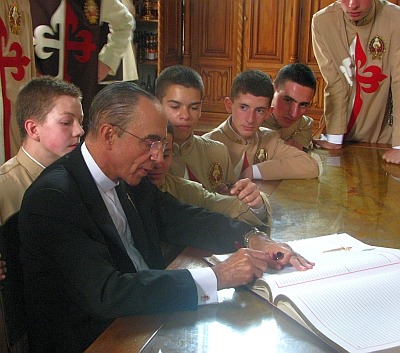
“O amor move o universo enquanto a Fé, as montanhas”
“Love moves the universe while Faith, the mountains.
Mons. João S. Clá Dias, 12-01-2010
Thabor (in English Tabor or Thabor) is a place where elevation and discipline reign. Banalities and lack of seriousness are naturally discouraged.
Naturally? Yes, naturally. In the sense that without needing to always having to drag a person, heavy with earthly thoughts and desires, to elevated things, he is in a situation where it is, in a way, the only thing possible. From a door handle that ennobles a simple closet to the way the indirect lighting creates a penumbra enveloping a corner with mystery, turning every detail into an occasion for elevation of the mind towards God. In creatures one can see an aspect of God, a principle behind a design and even opens the mind to the possibilities of things God could have created, wonders that exist in God’s infinite mind; these wonders that we hope to contemplate in Heaven. A prayer that really shows this spirit is one that the Heralds of the Gospel, who voluntarily live in a spirit of poverty, when are in need of some material good, end the request for them with it, adapted from the litany of the saints.
“Cor Sapientiale et Immaculatum Mariae, ut mentes nostras ad caelestia desideria erigas! Te rogamus, audi nos! ”
Even in the most simple situations, pulchrum involves the life of a herald, so that the union with God, Our Blessed Mother, the Choirs of the Angels and the Community of the Saints is always more intense. Everything proportions an opportunity for mystical graces to touch the deepest recesses of the soul.
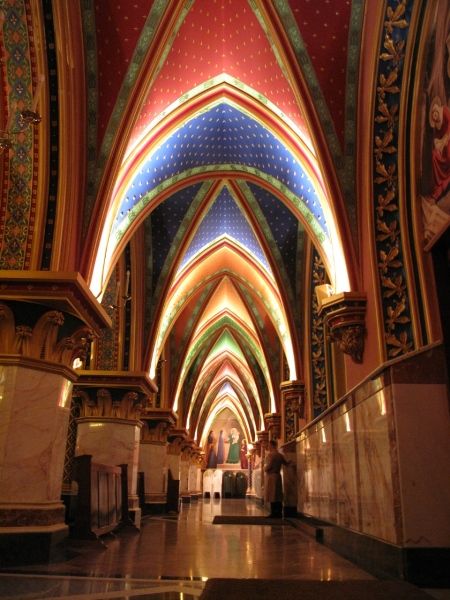
But then why discipline? Doesn’t the soul fly towards these wonders? Is this not the essential part of a holy person”s life?
Certainly. Without elevation man is nothing. We were created to contemplate and glorify God.
But this is precisely why we need discipline.
To be continued…
On Saturday January 8th, a program of religious formation took place at the Heralds house in Schomberg, ON geared to boys, grades 4 to 8.
This time, the boys had a power point presentation on the Eucharistic Miracle of Lanciano, tobogganing in the snow hills, a meeting about Grace and the Commandments, exposition of the Blessed Sacrament followed by half an hour adoration and the recitation of the Rosary, ended with the traditional Heralds Pizza.
Youth activities take place every 2nd and 4th Saturday of the month at the Heralds House, 5535 17th sideroad, Schomberg, ON, @ 2:30 P.M
The next meeting is scheduled for January 22nd, 2010. For more information contact Br. Gustavo Kralj at 647-283-0310
no images were found
From Mr Emmanuel Batagata, companion of the Heralds of the Gospel in Rwanda:
“We have also a young choir composed by 25 girls we are in need of uniform for them and musical instruments. The Apostolate of the Shrine is active in many parishes : Rango, Nyumba, Butare, Ngoma (Butare Diocese) and Muhondo and Shyorongi (Kigali Archidiocese).
At present, 350 families are members of the Apostolate of the Shrine and visits among families continue with Immaculate Heart of Mary.
In June 26th, 2011, we will celebrate 5 years of this work of evangelization in Rwanda.”
no images were found
It is a really nice video of scenes around the seminary.
It is in Portuguese, but the spoken part is minimal as it is mainly scenes.
Enjoy!


Tabor (Thabor in Portuguese) is the name of the international seminary of the Heralds of the Gospel (The Society of Apostolic life of Pontifical Right Virgo Flos Carmeli). It comprises the Major Seminary, Minor Seminary, Church and TV studios of the Heralds of the Gospel.
It is the main place where our future priests and consecrated receive their formation. In here they will not only study theology, philosophy and other ecclesiastical disciplines, but will formed into holy men. In a life full of prayer and study, guided by discipline and love of perfection they learn to “be perfect, as your heavenly Father is perfect.” (Matthew 5:48)”
At the Major Seminary, St. Thomas Aquinas, the young Heralds study the Church disciplines, always with a particular love for the via pulchritudinis. At the minor seminary, young aspirants begin their steps in the religious life with joy, starting from middle school to high school.
The Heralds of the Gospel always strive for the elevation of man to God through beauty and splendour. That is a keynote to Tabor. Everywhere and at all times is the young seminarian/novice surrounded by a an ambiance that elevates him towards contemplation. In a life full of ceremonials, the young Herald already begins to participate in the joys of the angels and saints in Heaven, feeling the peace God gives when we are in search of Him.
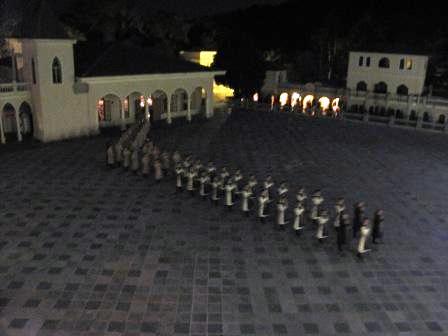
We wanted show you this wonder to let you participate in our joy. If you ever find yourself in São Paulo, Brazil, come visit us!
This is a first post on Tabor and we hope to post more. We’ ll be putting things on the daily life and activities of the Heralds of the Gospel in Thabor and Our Lady of the Rosary Church.
The pictures are all thanks to our seminarians there who run a blog on the seminary. Please visit them! thabor.blog.arautos.org